
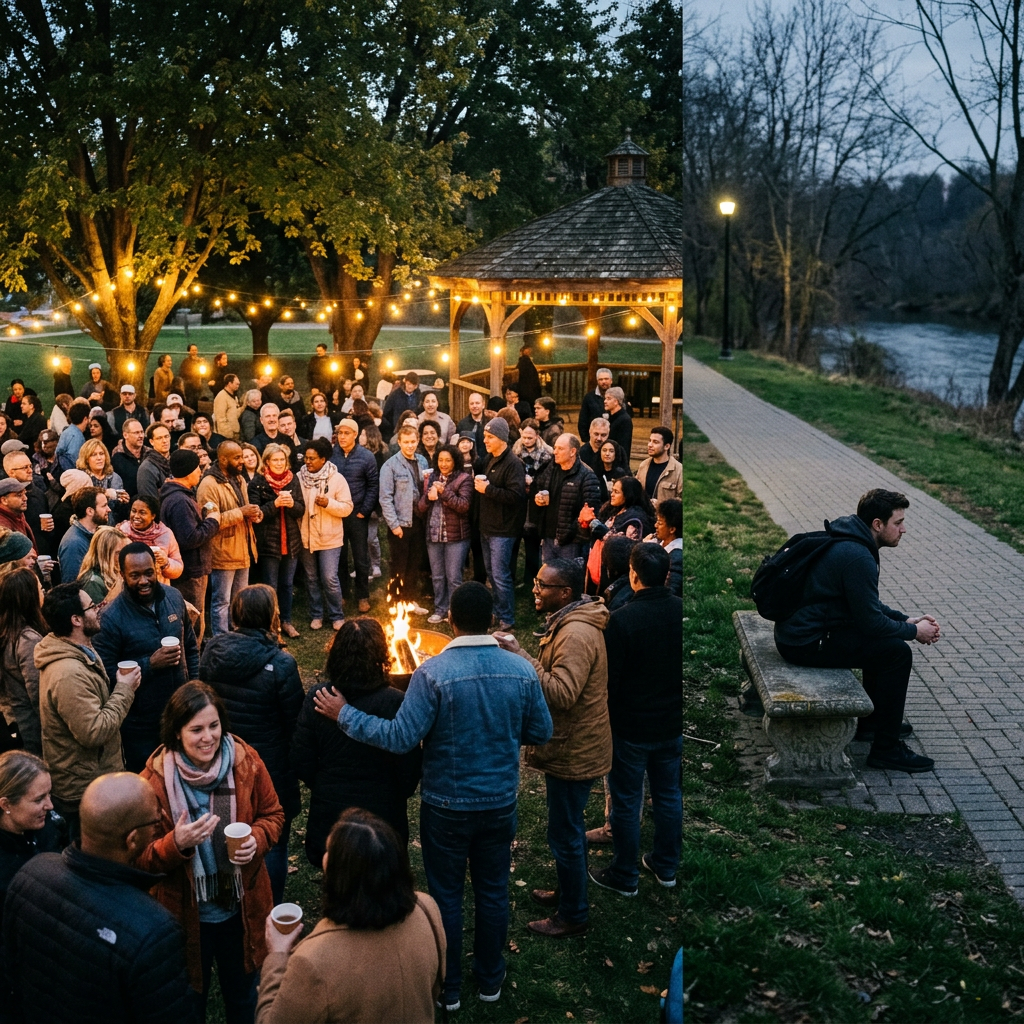
Over the last few years, I’ve noticed a recurring theme in conversations with people from all walks of life. Different ages, different backgrounds, different circumstances, yet the same sentiment keeps surfacing:
People feel alone.
Not physically alone. Many are surrounded by family, friends, coworkers, social media connections, and endless opportunities to communicate. Yet beneath the surface, there seems to be a growing sense of disconnection. More and more people are expressing that when life gets difficult, they don’t know who they can truly count on. Many describe feeling unseen, unsupported, or unsure where to turn when they are struggling.
It makes me wonder what has happened to our sense of community.
This isn’t about romanticizing the past or pretending previous generations had everything figured out. They didn’t. Every era has its challenges, blind spots, and struggles. But there was something fundamentally different about the way people showed up for one another.
When someone in the community experienced a hardship, people often stepped in. Neighbors brought meals. Friends helped with childcare. Family members checked in regularly. People understood that life was unpredictable and that everyone would eventually need support at some point. There was an unspoken understanding that we were all responsible for helping carry one another through difficult seasons.
Today, despite having more ways to communicate than at any other point in human history, many people feel less connected than ever.
Part of this shift has undoubtedly come from positive changes. Conversations around mental health, healing, boundaries, and self-awareness have become more common. For many people, this has been life-changing. Learning to establish healthy boundaries, recognize toxic relationships, and prioritize emotional well-being has helped countless individuals break cycles that have existed for generations.
These are important developments that shouldn’t be dismissed.
However, I sometimes wonder if we have unintentionally swung from one extreme to another.
For decades, many people were taught to sacrifice themselves for everyone else. Their own needs came last. Their struggles were minimized. Their exhaustion was ignored. The response to that imbalance was necessary.
Yet somewhere along the way, a culture of self-care has occasionally transformed into a culture of self-focus.
We hear phrases about protecting our peace, guarding our energy, and prioritizing ourselves. While these ideas have value, they can sometimes be interpreted in ways that encourage withdrawal rather than connection. Relationships become disposable. Difficult conversations are avoided. Supporting someone through a hard season is viewed as emotional labor rather than a natural part of being human.
As a result, many people are finding themselves in a strange paradox. They are actively working on themselves, setting boundaries, and pursuing healing, yet they feel more isolated than ever before.
What strikes me most is how often I hear stories about people finally finding the courage to be vulnerable and ask for help, only to discover that very few people are willing or able to meet them there.
These aren’t people looking for someone to solve their problems. They aren’t expecting to be rescued. More often, they’re simply hoping for presence. A conversation. A check-in. A reminder that they aren’t carrying everything alone.
Instead, many encounter discomfort, avoidance, or silence.
I don’t believe this happens because people are inherently selfish or uncaring. In fact, I think many people genuinely care. The issue may be that we are all carrying more than we know how to manage. We are overwhelmed, exhausted, distracted, and emotionally stretched thin. Many of us are operating with our own unresolved pain while trying to navigate an increasingly demanding world.
There is a popular saying that people can only meet you as deeply as they have met themselves.
There is certainly truth in that. Our capacity to support others is often limited by our willingness to face our own emotions and experiences.
But if that statement is accurate, then perhaps it reveals something much larger about our society.
If so many people struggle to sit with another person’s grief, loneliness, fear, or vulnerability, perhaps it is because we are struggling to sit with our own.
Maybe what we’re witnessing isn’t a lack of compassion but a collective exhaustion. A society that is overwhelmed, disconnected, and quietly hurting beneath the surface.
When I look around, I see evidence of this everywhere.
Rates of anxiety and depression continue to rise. Loneliness has become increasingly common. People are turning to countless forms of distraction and escape, whether through substances, food, social media, entertainment, shopping, work, or other compulsive behaviors. While these coping mechanisms look different from person to person, they often serve a similar purpose: helping us avoid emotions that feel too painful, overwhelming, or difficult to face.
At the core of many of these struggles is something remarkably simple.
Human beings need connection.
Not surface-level interaction. Not followers. Not likes. Not perfectly curated online lives.
We need genuine connection.
We need people who notice when something isn’t right. We need relationships where vulnerability feels safe. We need communities where support is not viewed as a burden but as part of what it means to belong.
The reality is that humans evolved in groups. For most of our history, survival depended on cooperation. We lived in tribes because life was too difficult to navigate alone. People shared responsibilities, resources, knowledge, and emotional support. Our nervous systems developed within environments where connection increased safety and isolation often signaled danger.
Yet today, many of us are attempting to navigate life’s challenges as individuals first and communities second.
Perhaps this is why so many people feel a persistent sense that something is missing.
Perhaps what we’re grieving isn’t simply the loss of relationships, but the loss of belonging itself.
I often think about something my father used to say: “You never know what you have until it’s gone.”
The older I get, the more I understand what he meant.
Many of us miss the certainty that someone would show up when life became difficult. We miss knowing where we belonged. We miss the feeling of being part of something larger than ourselves.
The answer isn’t to abandon boundaries or ignore the importance of healing. Healthy boundaries remain essential. Healing remains essential.
But healing was never meant to separate us from one another.
The goal of healing isn’t to become completely self-sufficient. The goal is to become healthy enough to participate in relationships, communities, and connections in a meaningful way.
Boundaries should help us build healthier connections, not eliminate connection altogether.
Perhaps what we need most is balance. A way of honoring our own well-being while remaining available to the people around us. A way of protecting our peace without losing our compassion. A way of prioritizing ourselves without forgetting our responsibility to one another.
Because despite everything that has changed, one truth remains constant:
Human beings have always needed each other.
And no amount of independence, achievement, healing, or self-improvement will ever replace the fundamental need to belong, to be seen, and to know that when life gets difficult, someone will be there beside us.
My prayer is that we return to what truly matters.
May we soften where the world has made us hard.
May we choose connection over isolation, understanding over judgment, and compassion over indifference.
May those who are struggling find the courage to reach out, and may those who are able find the courage to reach back.
May we remember that healing and boundaries are not meant to separate us from one another, but to help us love and support each other more fully.
And may we never underestimate the power of a kind word, a listening ear, or simply showing up when someone needs us most.
Above all, may we remember that none of us were meant to walk this journey alone.
Discover more from Angel Blessings
Subscribe to get the latest posts sent to your email.

 Angel Blessings
Thank-you for that!
❤️
M
LikeLike
You are welcome
LikeLike